
'Only four or five original companies remain; the rest have been replaced every decade as sectors evolve or leadership shifts.' 'Companies that fail to adapt -- like many textile mills from the 1970s and shipping firms from the 1980s -- disappear.' 'Benchmark indices reward those who reinvent themselves in line with economic demands.'
'The Pakistan establishment keeps him well protected.'

A blast on a railway track in Pakistan's Sindh province derailed five bogies of a train, injuring several people. The Peshawar-bound Jaffar Express has been attacked multiple times this year.

Tension grips Malkangiri district in Odisha after a tribal woman was beheaded, leading to clashes and property damage. Internet services are suspended as authorities work to restore peace.

Indian authorities have requested additional information from the United States based on the interrogation of Tahawwur Rana, an accused in the 2008 Mumbai terror attacks. The request was made through the Mutual Legal Assistance Treaty (MLAT).
'Those who call for war from far-off places should realise the repercussions it has on the people who are actually affected.'
'It is typical of China's strategic deception of making virtue out of necessity,' observes Rup Narayan Das.
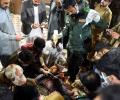
At least 27 terrorists were killed and 155 passengers rescued by the security forces after Baloch militants hijacked a passenger train in a tunnel in Pakistan's restive Balochistan province on Tuesday, security officials said.

Prime Minister Narendra Modi on Friday said the world has seen the power of India's indigenous weapons during Operation Sindoor, which is 'not over yet'.
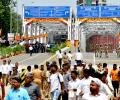
The reconstructed Carnac Road overbridge in South Mumbai has been renamed as Sindoor Bridge, a name inspired by India's military action against Pakistan to avenge the Pahalgam terror attack.

10 Heroes of the 1965 War which ended on September 23 60 years ago.
Soon after the explosion, the BLA militants started firing at the train indiscriminately.
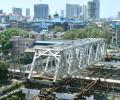
The east-west connector, earlier known as the Carnac Bridge and named after former Bombay Province governor James Rivett Carnac, who held the office from 1839 to 1841, has been rechristened as 'Sindoor Bridge' (after Operation Sindoor).
'Neither are Baloch insurgents capable of breaking up Pakistan, nor has Pakistan learned any lessons from the 1971 debacle that led to the country's dismemberment.'
'No military offensive by Pakistan will end the insurgency in Balochistan without simultaneous, concerted efforts toward political dialogue to de-escalate tensions.'

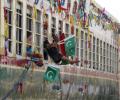
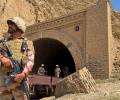
Insurgents opened fire on a passenger train in Pakistan's Balochistan province, injuring the driver and prompting security guards aboard the train to fire back. The attack occurred in the Bolan district on the Jaffar Express from Quetta to Peshawar. The train was stopped by armed men in Tunnel No 8, and efforts are being made to contact the passengers and staff. The Balochistan government has ordered emergency measures and all institutions remain active.
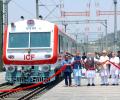
'Anybody who says one critical word can be branded as somebody who's glorifying terrorism.'
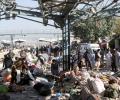
The explosion ripped through the provincial capital Quetta's railway station as passengers gathered on the platform before the scheduled departure of the Jaffar Express to Peshawar.

"Not only that, Pakistan is also the enemy of poor's bread and butter. What happened on April 22 in Pahalgam is an example of that. Pakistan attacked 'insaniyat' and Kashmiriyat in Pahalgam.
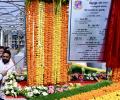
The reconstructed Carnac Road Over Bridge in Mumbai has been renamed 'Sindoor Bridge' as a tribute to the Indian military's 'Operation Sindoor'. The bridge, rebuilt after being declared unsafe, aims to ease traffic congestion in south Mumbai.
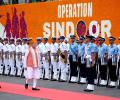
The bilingual -- Hindi and English -- invitation cards for I-Day anniversary celebrations carry this image on the top right corner of the invite, while the silhouetted image of the Chenab bridge, the world's tallest railway arch bridge, sits at the lower side of the cards, which have largely being issued online via 'Aamantran' website of the Ministry of Defence.
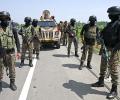
India needs to be technologically and militarily prepared to defend itself from both Pakistan and China, alerts Ramesh Menon.

Videos of Zinta asking spectators to vacate the stadium in an orderly manner also started doing rounds of the social media.
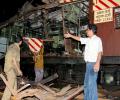
Nineteen years later, remembering how terror struck Mumbai's lifeline on July 11, 2006.

The defence minister, without naming anyone, said some people are not liking the rapid development of India and are unable to digest it.

Survivors of the 2006 Mumbai train blasts express shock and disappointment after the Bombay High Court acquitted all 12 accused, citing lack of evidence. They feel justice has not been served after 19 years.

Heavy security has been deployed at vital installations in Delhi, including government buildings and areas with high footfalls, following Pakistan's drone attacks on Indian military sites. Police have strengthened vigil in areas with high footfalls and have canceled leaves for all Delhi Police personnel. The developments come after India swiftly thwarted Pakistan's attempts to strike military sites with drones and missiles.
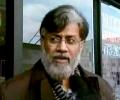
Tahawwur Hussain Rana, a jailed accused in the 2008 Mumbai terror attacks, has moved a court in New Delhi seeking permission to speak to his family. The 64-year-old Pakistani-origin Canadian businessman is currently in judicial custody and is accused of conspiring with David Coleman Headley and operatives of Lashkar-e-Taiba (LeT) and Harkat-ul-Jihadi Islami (HUJI) to carry out the terror attacks. Rana was brought to India after the American Supreme Court dismissed his review plea against his extradition.
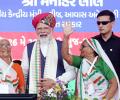
'The country that came into existence after Partition lives on hatred for India. It only wants to harm Bharat. However, India's goals are to remove poverty, bring about economic development and become a developed nation'

Sheikh Sajjad Gul, the head of Lashkar-e-Taiba proxy The Resistance Front (TRF), has been identified as the mastermind behind the Pahalgam terror attack that killed 26 people in April. Gul, who is based in Pakistan, has a history of planning terror attacks in Kashmir, including targeted killings, grenade attacks, and ambushes of police personnel. He was designated a terrorist by the NIA in 2022 and a reward of Rs 10 lakh was placed on his head. The TRF claimed responsibility for the Pahalgam attack, where tourists were shot at point-blank range after being asked their religion. Gul's history includes a 2002 arrest in Delhi for planning serial blasts and a subsequent 10-year prison sentence. After his release, he moved to Pakistan and became the leader of the TRF in 2019, a move orchestrated by the ISI to present a facade of an indigenous terror movement in Jammu and Kashmir.
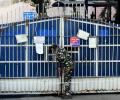
Tahawwur Hussain Rana, a Pakistani-born Canadian national accused in the 2008 Mumbai terror attacks, is likely to be lodged in a high-security ward in Tihar jail upon his extradition from the US. Rana, a close associate of David Coleman Headley, a US citizen who was also involved in the attacks, will be brought to India after his last-ditch attempt to evade extradition was rejected by the US Supreme Court. The attacks, which lasted nearly 60 hours, resulted in the deaths of 166 people and sent shockwaves across the country.
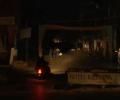
Blackout was imposed in Jaisalmer, Barmer and other border areas in Rajasthan on Sunday night as a precautionary measure in the wake of Saturday's violation by Pakistan of an understanding reached with India following four days of military confrontation.
'No one got punished for the irreparable damage and pain suffered by thousands of families'

"We're deeply grateful for the swift coordination and support from the BCCI, local authorities, and the police who made this possible," the RCB statement added.

The IPL match between Punjab and Delhi was called off mid-way on Thursday after Pakistan attempted to invade the airspace near Chandigarh with a drone attack, mandating an Indian retaliation.

The National Investigation Agency (NIA) has started interviewing eyewitnesses, including tourists, in connection with the deadly terrorist attack in Pahalgam, south Kashmir. The attack, carried out by terrorists from the Pakistan-based Lashkar-e-Taiba (LeT), claimed the lives of 26 people on April 22. Initial investigations suggest that five to seven terrorists were involved, aided by local militants trained in Pakistan. Security forces are conducting massive operations to hunt down the terrorists in the dense jungles of the Pir Panjal range.
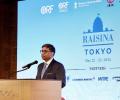
India's Foreign Secretary Vikram Misri has underscored the importance of not equating the victims and perpetrators of terror attacks, highlighting the need for global unity in combating terrorism. Speaking at Raisina Tokyo 2025, Misri expressed appreciation for Japan's support following the recent terror attack in Pahalgam, India. He also cautioned against the trend of some Western countries hyphenating India and Pakistan in the context of their recent military confrontation. Misri further outlined India's economic aspirations and its commitment to becoming a factor of stability in a turbulent world.

During his two-day Gujarat visit, PM Modi is scheduled to take part in public events in Dahod, Bhuj and Gandhinagar and inaugurate and lay the foundation stones for a series of development projects costing over Rs 82,950 crore, an official release stated.
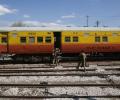
India has strongly rejected Pakistan's allegations of backing terrorism against that country following the Balochistan train attack. India said Islamabad should look inwards before shifting the blame on others for its "failures " and that the whole world knows "where the epicentre of global terrorism lies ". Pakistan, on the other hand, has accused India of "sponsoring terrorism " without directly implicating it in the Balochistan train attack that killed 21 passengers.
 © 2026 Rediff.com - Advertise with us - Disclaimer - Privacy Policy - Sitemap - Feedback - About us - Terms of use - Grievances